
Septoplasty

Duration
30-45 minutes
Downtime
1 week

Insurance
Covered
Lasts for
Long-lasting
Setting
Outpatient/Inpatient
Overview
Septoplasty realigns the deviated septum to the center of the nose, ensuring that both nasal cavities are equal in size, relieving nasal obstruction, and correcting the aesthetic appearance of the nose.
Understanding Your Condition
The septum is the wall dividing your nose into two passages. When deviated, one side becomes narrower, which restricts airflow.
The septum works with nearby structures called turbinates to regulate airflow. Enlarged turbinates can also contribute to obstruction.
.png&w=3840&q=82)
When to Consider Septoplasty?
Septoplasty may be right for you if you have:
Structural septal problems:
- Septal deformities from traumatic injury, severe infection, or birth defects
- Septal perforations resulting from trauma, drug abuse, excessive use of nasal sprays, or severe infections
A deviated septum causing:
- Chronic nasal obstruction that disrupts with daily life or sleep
- Recurrent nosebleeds that don't respond to conservative treatments (nasal packing, sprays)
- Recurring sinus infections that persist despite antibiotic treatment
- Persistent breathing disturbances during sleep (snoring, sleep apnea symptoms)
Benefits
Symptoms Improvement: Patients experienced 80-90% relief from nasal obstruction and 60-90% improvement in headaches.
Patient Satisfaction with Results: 75% of patients are satisfied with symptom improvement and recovery.
Procedure Types
Septoplasty can be done either as an open surgery or endoscopically. While there are no significant differences in the outcomes, endoscopy remains less traumatic and associated with minimal complications. Your surgeon will recommend the approach based on your deviation's location and severity.
Endoscopic Septoplasty
It is highly effective for correcting deviations in the back of the nose.
How is it performed?
The doctor inserts an endoscopic tool equipped with a camera and makes a small incision to correct the deviation
Conventional Septoplasty
This approach can treat anterior septal deformities better than the endoscopic one.
How is it performed?
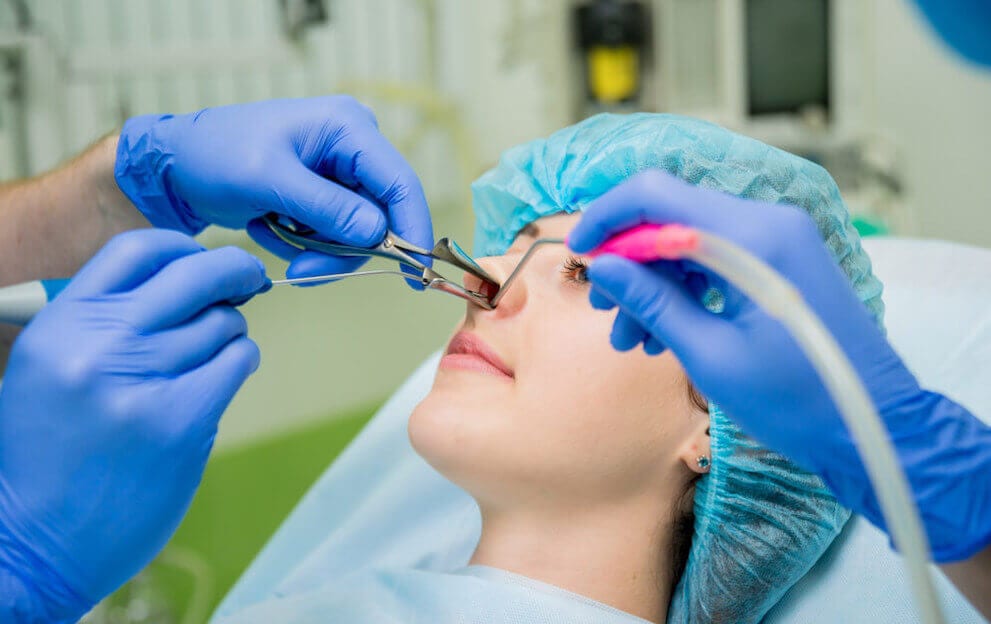
- Endonasal (through the nose): The doctor uses a speculum (a tool to expand the nasal opening) and makes an incision inside the nose (no scar)
- Extracorporeal (outside the nose): The doctor makes an incision from outside the nose, typically reserved for severe cases involving multiple nasal fractures. ( Visible scar)
Combination Therapy
Turbinate reduction: Septoplasty is commonly done with turbinate reduction since turbinate enlargement can be a cause of a deviated septum.
Rhinoplasty: Many patients undergo a rhinoplasty along with septoplasty because they are going under surgery anyway, and they want a cosmetic boost to their nose.
Having septoplasty along with other procedures makes the patient more prone to postoperative complications.
Risks
Septoplasty has an overall complication rate of 3.4-19%. They are mostly mild and manageable.
Complication | How likely is it going to happen? |
|---|---|
Bleeding ( the most common one) | 6-7% Brescia et al., 2023 |
Adhesions | 3.7% with splints and 8.7% without using splints (Kim et al., 2021) |
Infection
| ~3.5% if a prophylactic antibiotic was used (Dąbrowska-Bień et al., 2018) |
Temporary impaired smelling | ~3.1% and resolves spontaneously after 2-6 months. (Brescia et al., 2023; Watters et al., 2025)
|
Septal Perforation | ~2% (Dąbrowska-Bień et al., 2018)
|
Cerebrospinal fluid leakage | Very rare (~0.5%) (Dąbrowska-Bień et al., 2018) |
Patients can be at a higher risk if:
- They have active, uncontrolled, and untreated sinus or nose infections.
- They are active illicit drug users.
Navigation: